

The Glories of Lord Balarāma: Strength, Service and Spiritual Power
If Kṛṣṇa is the goal, where do we get the strength to reach Him?
This is why Lord Balarāma becomes especially dear to us. He is Kṛṣṇa’s first expansion, the original spiritual master and the source of spiritual strength. He protects us when we are weak and gives us the strength to continue serving Kṛṣṇa.
Śrīla Prabhupāda, explaining “Nāyam ātmā bala-hīnena labhyaḥ,” taught that spiritual realization cannot be attained without spiritual strength -and that strength comes from Balarāma. Just before Janmāṣṭamī, we celebrate Balarāma Pūrṇimā, His appearance day. His strength protects, His plough cultivates love, and His mercy carries us closer to Kṛṣṇa.
The meaning and significance of Name “Balarama”
The name Balarāma combines bala, meaning “strength,” and rāma, meaning “pleasure.” He is also known as Baladeva, Balabhadra, Saṅkarṣaṇa, Ananta and Rohiṇī-nandana. These names reveal different aspects of His transcendental personality.
According to Śrīmad-Bhāgavatam 10.2.13, He is called Balabhadra because of His extraordinary strength and Rāma because He gives pleasure to the residents of Gokula.
Balarāma’s strength, however, is not merely physical. He represents spiritual strength; the inner power needed to remain steady in devotional service, overcome material conditioning and progress toward Kṛṣṇa. His presence reminds us that spiritual life requires determination, shelter and the willingness to use our abilities in the service of the Supreme Lord.
Balarāma: Kṛṣṇa’s First Expansion
The Śrī Caitanya-caritāmṛta explains that Balarāma is Kṛṣṇa’s first bodily expansion:
eka-i svarūpa doṅhe, bhinna-mātra kāya
ādya kāya-vyūha, kṛṣṇa-līlāra sahāya
– Caitanya-caritāmṛta, Ādi-līlā 5.5
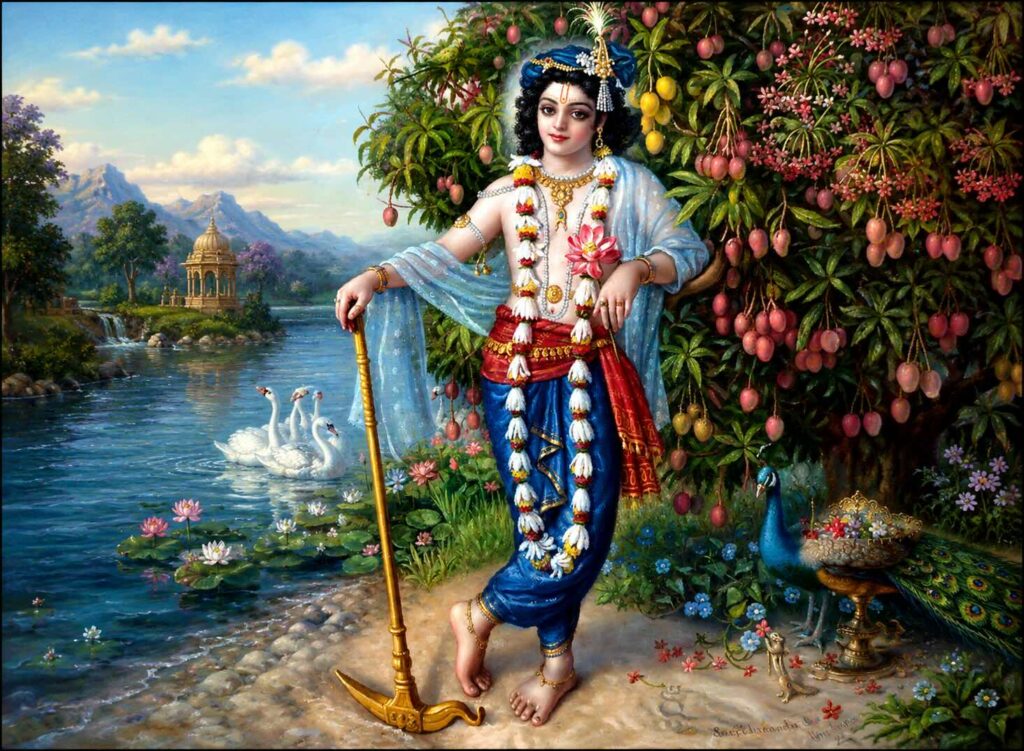
Kṛṣṇa and Balarāma are spiritually one, although They appear in different forms and perform different pastimes. Kṛṣṇa is dark-complexioned and carries His enchanting flute, while Balarāma is fair-complexioned and carries His famous plough.
For someone new to Vedic philosophy, this is a fascinating concept. Balarāma is not simply a powerful friend or brother of Kṛṣṇa. He is Kṛṣṇa’s own expansion, eternally assisting Him in His transcendental pastimes.
Balarāma: The Servitor Godhead
One of the most beautiful descriptions of Balarāma is “servitor Godhead.” The Śrī Caitanya-caritāmṛta describes how, in His Śeṣa form, Balarāma becomes Kṛṣṇa’s bed, pillow, throne, sandals, garments, residence and umbrella.
In the material world, strength is often associated with independence, authority and control. Balarāma presents an entirely different definition. The more powerful He is, the more He serves.
His unlimited strength gives Him unlimited opportunities to serve Kṛṣṇa. This teaches us that greatness and humility are not opposites. In spiritual life, true greatness is expressed through loving service.
Balarāma’s Birth: A Transcendental Appearance
Balarāma appeared before Kṛṣṇa in the Yadu dynasty.
Like His younger brother Kṛṣṇa, Balarāma also has a unique relationship with two mothers. He first appeared within the womb of Devakī, but by the arrangement of Yoga-māyā, He was transferred to the womb of Rohiṇī in Gokula. Thus, Balarāma is eternally connected with both Devakī and Rohiṇī, and He is especially celebrated as Rohiṇī-nandana, the beloved son of Mother Rohiṇī.
Balarāma’s appearance also prepares the way for Kṛṣṇa’s appearance. He accompanies Kṛṣṇa throughout His earthly pastimes as His eternal companion, protector and servant.
Lord Balarāma: The Original Spiritual Master
Balarāma’s connection with guru-tattva reveals the very purpose of the spiritual master. The bona fide guru is a representative of Balarāma, giving the disciple spiritual strength and guiding him toward Kṛṣṇa.
The spiritual master also embodies Balarāma’s mood of service. Balarāma eternally serves Kṛṣṇa in countless ways, and the bona fide guru similarly dedicates his life to Kṛṣṇa’s service and trains others to develop the same service attitude. As Śrīla Prabhupāda explains, the spiritual master’s eternal occupation is to expand the service of the Lord by training disciples in a service attitude. (CC Adi-lila 1.44)
Thus, Balarāma teaches us that true spiritual strength means gaining the determination to serve Kṛṣṇa faithfully and follow the guidance of guru.
The Plough of Lord Balarāma
If Kṛṣṇa is often recognized by His flute, Balarāma is immediately recognized by His plough, or hala. The plough is more than a weapon; it offers a beautiful symbol for spiritual life.
A farmer uses a plough to cultivate hard earth and prepare it for planting. Similarly, our hearts can become hardened by pride, envy, false ego, attachment and material desires. The heart requires cultivation before the seed of devotion can flourish.
Balarāma’s plough therefore reminds us that spiritual transformation may require us to uproot what prevents us from serving Kṛṣṇa. We can pray, “Balarāma, please cultivate my heart. Remove whatever keeps me away from Kṛṣṇa.”
Balarāma in Vṛndāvana: Kṛṣṇa’s Elder Brother
Balarāma’s greatness becomes especially sweet when we see Him in Vṛndāvana. He walks through the forests with Kṛṣṇa and the cowherd boys, plays with them, jokes with them, tends the cows and enjoys intimate childhood pastimes.
The Śrīmad-Bhāgavatam describes Kṛṣṇa and Balarāma wandering through Vṛndāvana with the cowherd boys and enjoying various playful activities. These simple-looking pastimes reveal the extraordinary sweetness of Vṛndāvana, where the Supreme Lord allows Himself to be completely absorbed in loving relationships.
Dhenukāsura and Pralambāsura: Balarāma Uses His Strength to Protect Devotees
Balarāma’s protective strength is beautifully demonstrated in His pastime with Dhenukāsura.
The Tālavana forest was filled with delicious palm fruits, but the residents of Vṛndāvana were afraid to enter because Dhenukāsura, a powerful ass-demon, controlled the forest. When the cowherd boys expressed their desire to taste the fruits, Kṛṣṇa and Balarāma went with them.
Balarāma shook the palm trees, causing the fruits to fall. Dhenukāsura attacked Him, but Balarāma seized the demon by the legs, whirled him around and threw him into a palm tree. Kṛṣṇa and Balarāma then defeated the demon’s associates. (Śrīmad-Bhāgavatam 10.15)
Balarāma also killed Pralambāsura, who had entered Kṛṣṇa’s group of cowherd friends in disguise. These pastimes show that Balarāma’s strength is always used for protection and to remove obstacles to devotional service.
What Can We Learn From Lord Balarāma?
For devotees, Balarāma is a source of shelter. When our determination becomes weak, we can remember Him. When our heart becomes hard, we can pray for His mercy. When we struggle to continue in devotional service, we can seek His strength. He teaches us that:
- Strength should be used to serve, not dominate.
- True protection means helping others move toward spiritual well-being.
- Humility is not weakness.
- Spiritual progress requires strength and determination.
- The heart, like farmland, must be cultivated.
- The greatest happiness comes from loving service.
His greatest glory is His unlimited service to Kṛṣṇa.
No comment yet, add your voice below!